
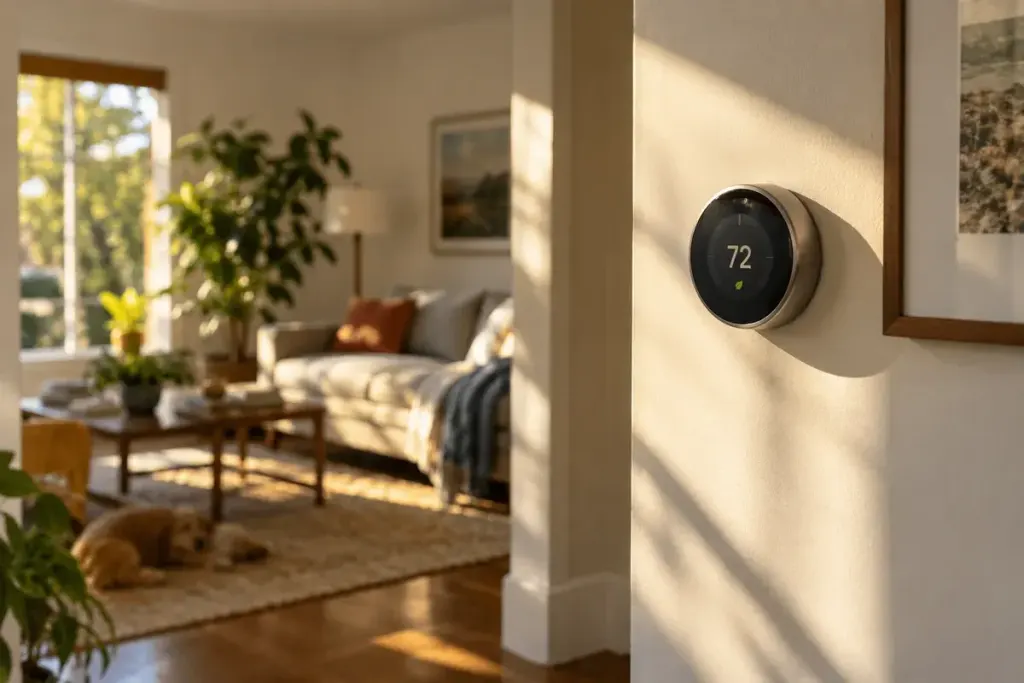
The thermostat says the room is comfortable, but your chair by the window tells a different story. Both observations can be real. A thermostat measures conditions at its sensor, while your experience also depends on where you sit, nearby surfaces, draughts and the system’s recent cycle.
Before changing several settings, write down when the mismatch occurs. An afternoon problem near a sunny window may have a different explanation from a room that is consistently colder throughout the day.
Compare places at the same time
If you have a suitable room thermometer, first compare it near the thermostat without touching the wall or placing it in direct sunlight. Allow it to settle according to its instructions. Then observe the area where you normally sit. Two devices may have different accuracy and response times, so a small difference is not proof of a fault.
Record the time, location, weather conditions and whether heating or cooling is running. A few comparable observations are more useful than moving the thermometer repeatedly and reading it immediately.
Look for local influences
Sunlight, a nearby lamp, a television, a supply vent or a draught can influence the sensor’s surroundings. The US Department of Energy notes that heat-producing appliances near an air-conditioning thermostat can cause unnecessary operation. That example illustrates why placement matters; it does not diagnose every comfort problem.
Check whether furniture restricts ordinary airflow around the thermostat. Also look at the room itself: a closed door, blocked register or very different sun exposure may help explain the pattern. Do not obstruct vents or alter equipment in an attempt to force a result.
Understand the displayed number
Some displays show the target temperature prominently, while others show the measured temperature. Remote sensors, schedules and occupancy settings can change which reading controls the system. Consult the manual for the exact model rather than assuming the largest number is the current room temperature.
Avoid moving a wired thermostat or changing installer settings as a first experiment. Compatibility and wiring differ, and a seemingly simple change can affect heating or cooling operation.
Bring your notes to a qualified HVAC technician if the mismatch is persistent, large or accompanied by unusual cycling or other system problems. A description such as “the west-facing room becomes uncomfortable after 3 pm while the hall reading stays steady” gives them a useful starting point. “The thermostat is wrong” closes the investigation too early.