
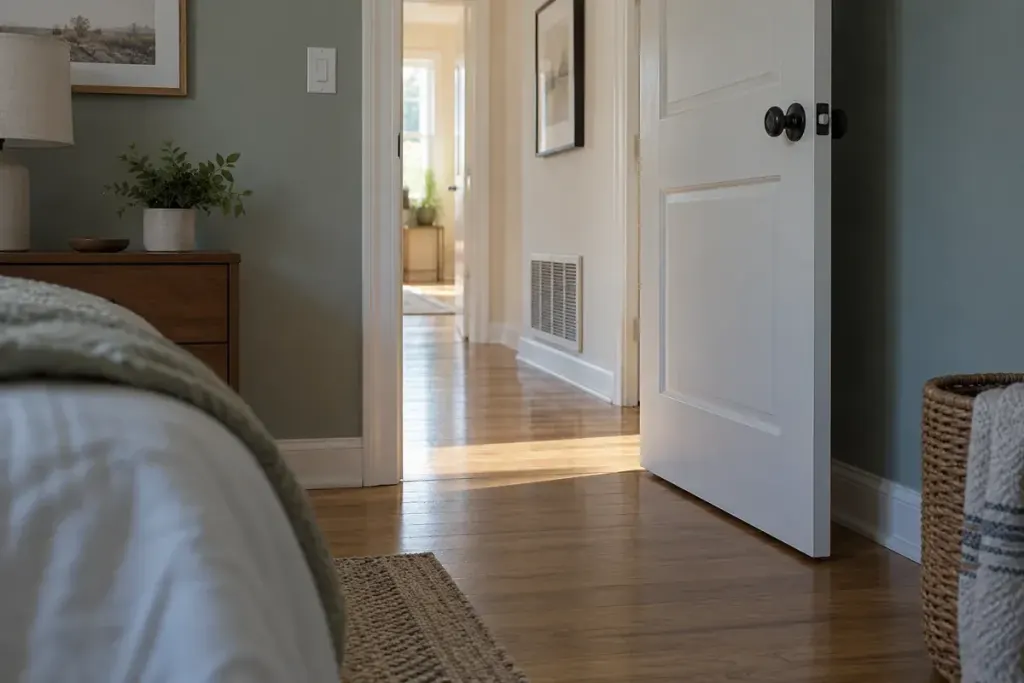
A bedroom feels comfortable with the door open but stuffy or noticeably different after it stays closed. The thermostat has not moved. The missing clue may be the route air takes back to the heating or cooling equipment.
In a ducted system, supplying air to a room is only part of the circulation. The return path also matters. A closed door can affect that path depending on how the home was designed.
Learn what your system actually uses
The US Department of Energy’s overview of ducted returns describes dedicated returns and other strategies such as transfer grilles, jump ducts and door undercuts. Their suitability depends on the design; the presence of a small gap does not prove that it is adequate.
Identify visible supply and return grilles without dismantling anything. Do not assume every grille has the same purpose or that a room needs a particular modification based on a photograph online.
Record a repeatable observation
Note when the comfort difference occurs, whether the system is running and how the door is positioned. Keep other conditions as consistent as practical. A sunny afternoon and a cool evening are not a fair comparison of door position alone.
A useful note might say: “After the door remains closed during normal cooling, the room feels warmer than the hallway; the pattern repeats on several evenings.” That gives a technician a starting point without claiming a diagnosis.
Check simple obstructions, not improvised fixes
Ensure furniture or stored items are not blocking grilles, following the system’s guidance. Do not cut a door, add a vent or alter ductwork simply to copy another house. Fire, acoustic, pressure and building requirements can all affect the appropriate solution.
Nor should you leave a door open if doing so conflicts with a safety requirement or the household’s needs. The aim is a system that works under the intended conditions, not a workaround that creates a different problem.
Ask for measurement and explanation
A qualified HVAC professional can assess airflow and pressure relationships and identify other causes of uneven comfort. Ask which observation supports the proposed change and how its effect will be checked afterwards.
The gap beneath a door is easy to overlook because it looks like a carpentry detail. In some homes it is also part of the air path—one reason comfort problems benefit from looking at the whole system rather than only the thermostat setting.