
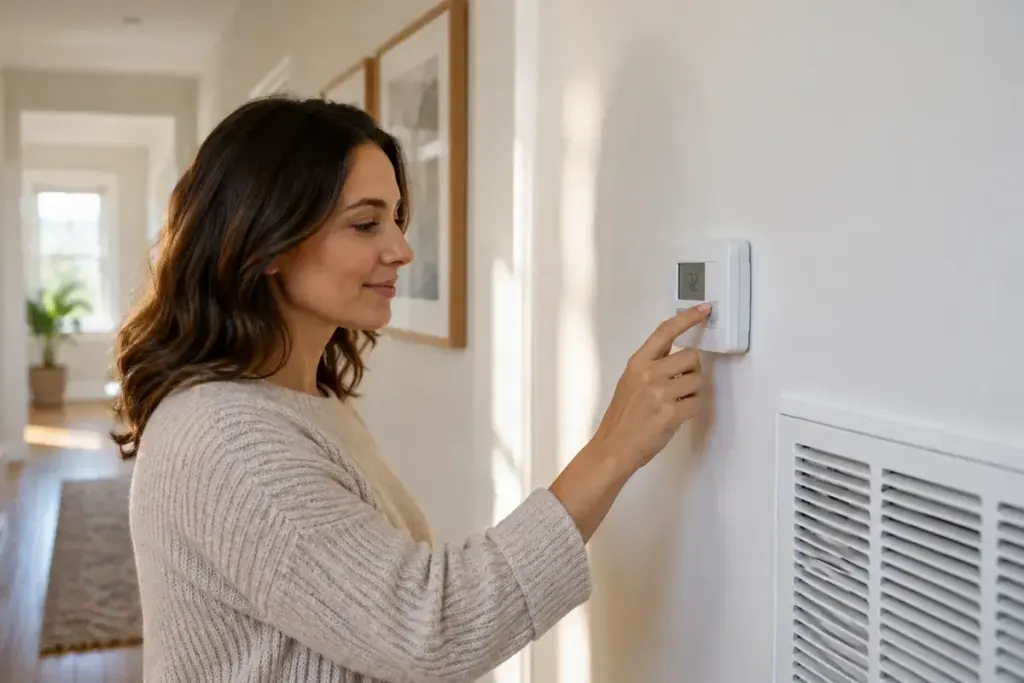
The cooling has stopped, but air still comes through the vents. That may be an intended fan setting rather than proof that the thermostat is ignoring its target. Before changing the temperature again, identify which control governs the fan.
Many thermostats display both a system mode and a fan mode. The same word, “auto”, can appear in more than one place and refer to different behaviour.
Read the label around the setting
Carrier’s thermostat explanation distinguishes fan operation during active cooling from continuous fan operation. The exact behaviour depends on the thermostat and connected equipment; variable-speed systems and circulation programmes may offer additional options.
Check your manual for “fan”, “circulate” or a scheduled ventilation feature. Do not assume that selecting an automatic heating-and-cooling mode also changes a separately selected continuous fan setting.
Observe one ordinary cycle
Note the displayed mode, setpoint and room reading, then observe whether airflow continues after the active heating or cooling indication ends. Record the time and any relevant schedule setting. This is an observation, not a reason to open electrical panels or alter wiring.
Air movement does not necessarily mean the system is actively cooling. A fan can circulate air between cycles, and the effect on comfort, energy use and moisture depends on the installation. Ask a qualified HVAC professional if you are unsure which setting suits your system.
Change one user setting, if appropriate
If the manual allows the change and there is no specific professional instruction to maintain the existing mode, compare one supported setting at a time. Keep a note of the original so you can restore it. Avoid changing temperature, schedule and fan mode together, which makes the result hard to interpret.
Persistent unusual noise, water, odour or failure to maintain comfort needs appropriate service rather than repeated menu experimentation. Follow the manufacturer’s safety instructions.
The useful discovery may be simple: the fan is doing exactly what its own control requests. Understanding that distinction makes the next conversation about comfort much more precise than saying only that the air conditioner “never stops”.